
The origins and lineage of Auricular Medicine—Part 1
The origins of Auricular Medicine
So much of my practice revolves around the ears! You might be wondering why that is. The simple answer is that the ear contains a representative map of the entire body, including the musculoskeletal system, the organs, and the central nervous system. This map is projected onto the ear by the brain, which acts as a relay through which we recognize and experience illnesses and pain syndromes in our body. Those experiences are then projected by the brain onto the ear. By treating the ear, a signal is recognized by the brain, and sent to the part of the body in need of help. Thus, the ears give the practitioner a two-way avenue for direct communication with the brain in a way that impacts healing anywhere in the body.
Now that the fundamentals are out of the way, let’s dive deeper into how Auricular Therapy/Medicine has developed over the decades. This will be a two-part article. Here in Part 1 we will explore the origins of Auricular Medicine, and in Part 2 (July/August), we will learn about its lineage up to today.
The birth of Auricular Therapy
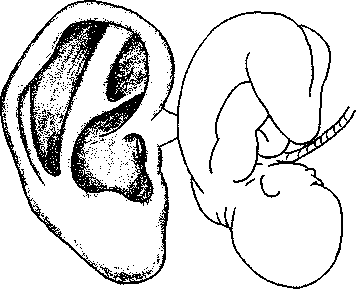
Auricular acupuncture began in China, but its in-depth development occurred in Europe, beginning in the 1950s. As the story goes, the French neurologist Dr. Paul Nogier noticed a scar on the ears of several of his patients. The patients reported that the scars were the result of an effective treatment for sciatica, performed by a lay practitioner of this particular treatment. Dr. Nogier was intrigued, and proceeded to do further research, ultimately discovering that the entire body is mapped on the ear in the configuration of an upside-down fetus.
In 1956, Dr. Nogier’s findings were published in an international acupuncture journal. The Chinese adopted this ground-breaking, foundational information, and built upon it using the traditional Chinese medicine system. As Nogier continued to research Auricular Therapy, he worked with Dr. Frank Bahr of Germany and Dr. Rene Bourdiol of France. Through these connections, European Auricular Therapy continued to develop in France and Germany. The French, German, and Chinese systems share a lot in common, but there are distinctive features within each system.
Nogier’s three-phase Auricular Therapy
Nogier noticed that the Chinese ear maps included different organ locations from his inverted fetus ear map. He found that the Chinese points were also effective in relieving conditions. This information fueled discovery of his three-phase system. Nogier found that the map changed depending on how chronic the condition was. Phase 1, the acute phase, was represented by the original inverted fetus map. Phase 3, the sub-acute phase, and Phase 2, the chronic/degenerated phase, each have their own distinct map. (Yes, the numbers are out of order … they are in the order that Nogier discovered and mapped each phase.) For example, if someone has chronic low back pain, but the tissues are still mostly intact, they may have active points in both Phase 1 and Phase 3.
Auricular Therapy evolves into Auricular Medicine
Vascular Autonomic Signal
In 1965, Dr. Nogier first identified the Vascular Autonomic Signal (VAS). The VAS appears as an exaggerated pulsing, most often monitored at the wrist, when the body experiences a change in stimulation—a stress response to a particular stimulus. In other words, a point that elicits a strong VAS is a point that is experiencing a lot of stress, pain, or dysfunction. By exposing the body to different tools, such as color filters, vials containing various substances, specific frequencies, flower essences, and homeopathic remedies, and monitoring changes in the VAS, the practitioner can gather information about the nature of the pathology, as well as learning which points are active and should be treated. The VAS adds complexity and nuance to both the assessment and the treatment. Use of the VAS is what elevates the practice to Auricular Medicine. If you are curious to learn more about the VAS, the 5-minute video below is very informative.
Bioenergetic field testing
The bioenergetic field that is projected beyond the ear is another assessment tool that expanded the practice of Auricular Medicine. A three-phase filter (composed of a stack of three Kodak color filters, each identifying one of Nogier’s three phases) is slowly moved laterally towards the ear until a VAS is felt. A normal bioenergetic field is 1 cm away from the ear. Anything farther out identifies dissonant or stressed energy in the field.
Bioenergetic field testing is used during the assessment to identify changes in the patient’s field as the body is exposed to different energetic challenges and information, all while monitoring the VAS. These challenges include a wide variety of things, including immune stressors (virus, bacteria, fungus, parasites), toxic stressors (chemicals, heavy metals), hormones, allergens, foods, autoantibodies, organs, anatomical structures, particular disease patterns, etc. The information gleaned from this process forms the basis of the unique protocol created for each individual.
Dr. Nogier was responsible for developing a highly robust therapeutic method that makes the most out of the microsystem that exists on our ears. The practitioners who we will discuss in Part 2 have taken Nogier’s discoveries and added many more powerful innovations for us to benefit from.
Marie's Body of Knowledge
Have you been diagnosed with tendinitis, bursitis, or another inflammatory condition? Was a cortisone shot suggested to decrease inflammation and reduce pain? Did you decide to get the cortisone shot, and lo and behold, the pain was significantly reduced or eliminated? So now what?
The fact of the matter is, the pain is improved but the problem is not resolved. Generally, poor mechanics, overuse, or muscle weakness has led to the inflammation and pain. The cortisone injection has reduced the pain but the underlying cause continues to persist.
Once the cortisone injection has reduced pain and improved function, that is the time to seek the help of a physical therapist. A PT will perform a thorough evaluation and identify joint dysfunction, muscle weakness, and faulty mechanics that led to the problem. Without manual therapy and the help of an individually designed exercise program, the pain and inflammation will most likely return within a few weeks to months, because the underlying cause hasn’t been resolved.
A physical therapist can perform hands-on therapy techniques to decrease muscle tension and improve joint mechanics. When mechanics improve, then exercises to strengthen weak muscles can begin to improve overall long-term function. In general, it takes 6-8 weeks of diligently performing exercises to restore strength and mechanics.
After a cortisone injection, give yourself the best chance for long-term pain relief. Seek out a physical therapist to help you back on the road to recovery.